 EN
EN

1. The Science Behind Collagen Remodeling and Scar Reduction
Understanding why fractional CO2 laser therapy works effectively for deep acne pits requires analyzing the biological structure of atrophic scars. Following severe acne inflammation, the body often repairs tissue by laying down collagen fibers in a haphazard, disorganized pattern. This creates tight, fibrous bands that pull the skin surface downward, resulting in a pitted appearance.
The Regenerative Healing Mechanism:
-
Microscopic Ablation Zones: The fractional CO2 laser targets the skin with a 10,600 nm wavelength, which is highly absorbed by the water in human tissue. It creates columns of vaporized tissue (microthermal zones) that extend deep into the dermis while leaving the surrounding healthy skin completely intact.
-
Fibroblast Activation: Each tiny micro-injury column triggers a controlled inflammatory response. This recruits fibroblasts to the area and activates matrix metalloproteinases, which systematically break down the old, disorganized scar tissue.
-
Organized Collagen Synthesis: Over the following weeks and months, the body synthesizes new collagen and elastin fibers. This new structural matrix is laid down in an organized, parallel arrangement that restores volume and smoothness to the skin surface.
Clinical Insight: According to dermatological studies, fractional CO2 laser technology modulates key molecular pathways—including TGF-beta, heat shock proteins, and basic fibroblast growth factor. This fundamentally reprograms the skin's healing response from a scar-forming pattern to a highly regenerative one.
2. What Real Treatment Looks Like from the Clinic Floor
A successful fractional CO2 laser treatment relies heavily on a clinician's ability to precisely control parameters based on the patient's unique scar topography and skin type. Advanced modern medical laser systems offer highly customizable settings to achieve optimal tissue ablation.
Tailoring Parameters to Specific Scar Types
| Scar Classification | Structural Profile | Clinical Treatment Strategy |
| Icepick Scars | Deep, narrow, and sharp pits extending into the deep dermis or subcutis. | Smaller spot sizes paired with higher energy density (e.g., 150 to 200 mJ per microbeam) to penetrate the full depth of the narrow scar tract. |
| Rolling & Boxcar Scars | Broader depressions with either sloping edges (rolling) or sharp, vertical borders (boxcar). | Larger scan patterns with a moderate microbeam density to resurface the broad, uneven zones smoothly and uniformly. |
Considerations for Different Skin Tones (Fitzpatrick Scales)
-
Types I & II (Lighter Skin): Can typically tolerate higher energy densities and higher pulse densities with standard recovery timelines.
-
Types III, IV & Above (Darker Skin): Highly prone to post-inflammatory hyperpigmentation (PIH). Clinicians must carefully titrate the fluence, utilize lower pulse densities, and schedule longer intervals between sessions to ensure safety while still promoting effective collagen synthesis.
Modern laser platforms streamline this process by incorporating versatile user interfaces, allowing operators to select multiple scan shapes, adjust pulse widths (ranging from ultra-short durations like 0.1 ms up to 50 ms), and configure densities dynamically.
3. Safety Profile, Downtime, and Patient Expectations
While traditional, fully ablative CO2 lasers required extensive recovery periods due to complete removal of the epidermal layer, modern fractional technology significantly reduces patient downtime while maintaining high clinical efficacy.
The Recovery Timeline:
-
First 48 Hours: The treated area experiences mild swelling, redness, and a sensation similar to a moderate sunburn.
-
Days 3 to 5: The skin takes on a temporary bronzed appearance. The microthermal zones begin to flake and peel as the skin undergoes rapid re-epithelialization.
-
Day 7 onwards: Most patients can comfortably return to routine social and professional activities. A mild residual redness (erythema) may persist for two to four weeks depending on the aggressiveness of the session.
Essential Post-Treatment Care Protocols
Because newly forming collagen is highly vulnerable to environmental factors during the healing phase, strict adherence to aftercare is mandatory:
-
Strict Sun Avoidance: Patients must protect the healing skin from direct UV exposure to prevent pigmentary changes.
-
Broad-Spectrum Protection: Daily application of a physical broad-spectrum SPF 50 sunscreen is required once the skin has closed.
-
Gradual Results: Collagen remodeling is a slow, progressive biological process. While initial skin smoothing is visible early on, the most dramatic improvements in scar depth manifest between two and six months after completing a full series of three to five sessions.
4. Why Choosing the Right Laser Platform Matters
For medical clinics and aesthetic practices, the internal engineering of the CO2 laser system directly dictates clinical consistency and patient satisfaction.
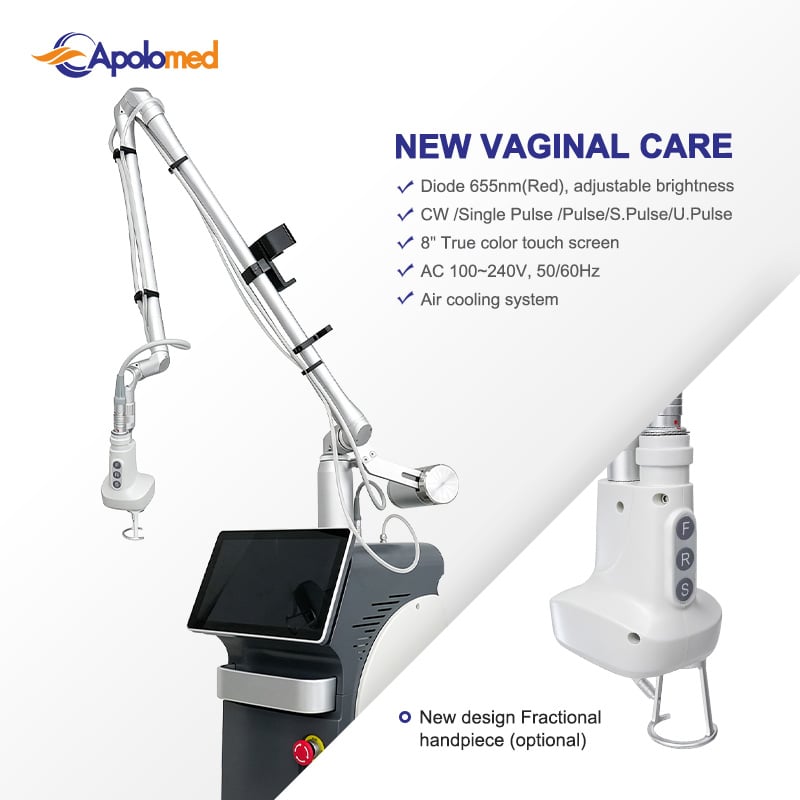
Premium platforms utilize high-quality radiofrequency (RF) sealed-off CO2 tubes rather than traditional glass tubes. RF tubes deliver a highly stable energy output over an extended operational lifespan, ensuring that the microbeams penetrate to the exact intended dermal depth without unexpected power drops. Furthermore, devices capable of delivering ultra-short pulse widths (down to 100 microseconds) confine the thermal energy strictly to the target column. This minimizes unnecessary heat diffusion to the surrounding tissue, reduces peripheral thermal damage, lowers the risk of complications, and accelerates the overall healing cycle for the patient.
5. Conclusion
Fractional CO2 laser resurfacing remains one of the most clinically reliable and effective modalities available for the correction of atrophic acne scars. By delivering precise, fractional micro-injuries deep into the dermis, it successfully dismantles old, fibrous scar tissue and prompts the body to construct a smooth, organized collagen network. When performed by a trained practitioner using a certified, highly adjustable medical device, this treatment offers a customizable, safe, and transformative solution for patients seeking long-term structural skin repair.