 EN

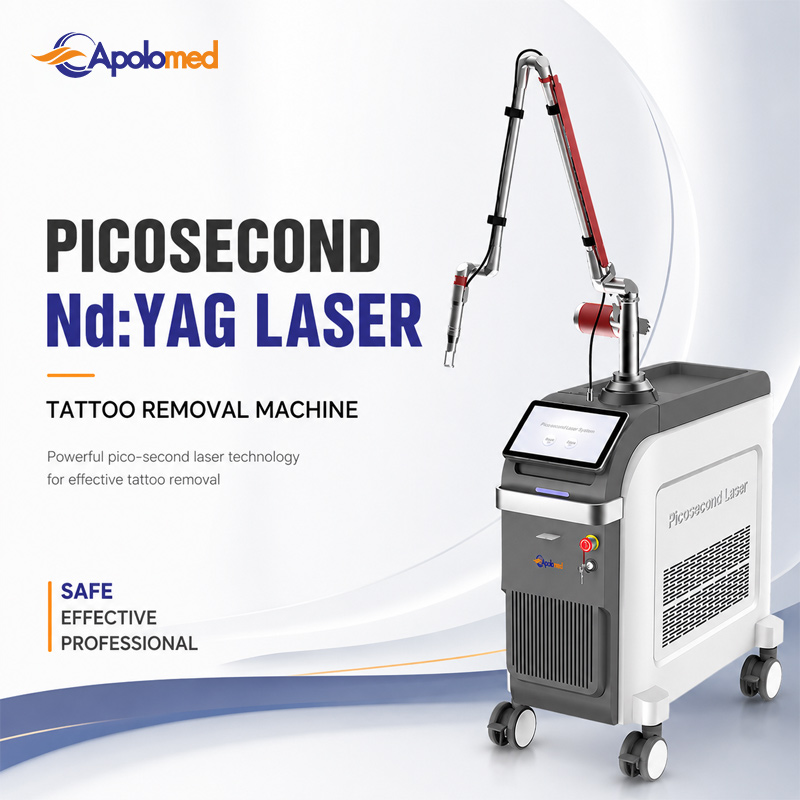
Why Picosecond Lasers Improve Removal of Green, Yellow, and Turquoise Tattoos
Why Traditional Lasers Struggle with Green, Yellow, and Turquoise Tattoos
Absorption Spectrum Limitations: Why Nanosecond Lasers Often Underperform on Resistant Pigments
Traditional Q-switched nanosecond lasers have been widely used for tattoo removal for decades, but their effectiveness depends heavily on matching the laser wavelength with the optical absorption characteristics of tattoo pigments. This principle, known as selective photothermolysis, requires sufficient absorption of laser energy by the target ink particles while minimizing damage to surrounding skin.
Most conventional nanosecond systems rely on a limited number of wavelengths, including 1064 nm Nd:YAG, 532 nm KTP, and occasionally 755 nm alexandrite. These wavelengths are highly effective for certain pigments, particularly black and dark blue inks, but some colors remain challenging because their absorption characteristics do not align well with commonly available wavelengths.
Green, turquoise, and certain yellow pigments often demonstrate lower absorption efficiency with traditional wavelength options. As a result, nanosecond pulses may deliver insufficient energy directly into the pigment particles, reducing fragmentation efficiency and requiring more treatment sessions.
The limitation is not simply related to laser power or operator technique—it is largely determined by the interaction between wavelength, pulse duration, and pigment composition. Picosecond technology addresses this challenge by delivering energy in much shorter pulses, improving pigment fragmentation efficiency through a stronger photoacoustic effect.
Thermal Diffusion and Pigment Characteristics Affect Treatment Response
Nanosecond lasers primarily rely on photothermal effects, where absorbed laser energy converts into heat that breaks down tattoo pigments. However, some tattoo colors contain highly reflective or complex pigment compounds that limit efficient energy absorption.
White, pastel, and some orange pigments may contain titanium dioxide or other inorganic materials that can scatter laser energy. This reduces the amount of energy converted into effective pigment disruption. In some cases, light-colored cosmetic pigments may also undergo color changes after laser exposure, requiring careful wavelength selection and conservative treatment parameters.
Because nanosecond pulses remain active for several billionths of a second, more heat can spread into surrounding tissue compared with ultra-short pulse systems. This may increase recovery time and limit treatment efficiency for certain pigment types.
Picosecond lasers reduce this limitation by delivering energy faster than significant thermal diffusion can occur, allowing more mechanical disruption of pigment particles while maintaining a favorable safety profile.
How Picosecond Laser Technology Improves Clearance of Resistant Tattoo Colors
Photoacoustic Fragmentation Through Ultra-Short Picosecond Pulses
Picosecond lasers operate with pulse durations measured in trillionths of a second, creating extremely high peak power during each pulse. Instead of relying mainly on heat generation, these ultra-short pulses generate rapid pressure changes that produce photoacoustic effects inside tattoo pigment particles.
This mechanical stress helps break larger ink particles into smaller fragments that can be gradually processed and removed by the body's natural immune response.
Unlike traditional nanosecond systems, the shorter pulse duration reduces unnecessary heat accumulation in surrounding tissue. This allows clinicians to treat challenging tattoo colors with improved control while maintaining skin safety.
Modern picosecond platforms often combine multiple wavelengths, such as 1064 nm, 755 nm, and 532 nm, enabling practitioners to select the most appropriate wavelength based on pigment color, skin type, and treatment goals.
Smaller Pigment Fragments Support More Efficient Natural Clearance
Tattoo pigments are deposited deep within the dermis, where they are gradually stabilized by immune cells after tattooing. Laser treatment works by disrupting these pigment particles so the body can process and remove them over time.
Picosecond laser pulses create finer pigment fragmentation compared with traditional thermal-based approaches. Smaller particles can be more accessible to immune clearance pathways, contributing to progressive fading after each treatment session.
However, treatment results depend on many factors, including:
- tattoo age;
- pigment composition;
- ink density;
- treatment wavelength;
- skin type;
- individual healing response.
For this reason, multiple treatment sessions are typically required, and complete clearance cannot be guaranteed for every tattoo.
Clinical Performance of Picosecond Lasers on Difficult Tattoo Colors
Green and Turquoise Tattoos: Improved Response with Appropriate Wavelength Selection
Green and turquoise pigments have historically been among the most difficult colors to treat because many traditional wavelengths provide limited absorption.
Picosecond systems using appropriate wavelengths, particularly 755 nm alexandrite technology, have demonstrated improved performance for many green and turquoise tattoo pigments. The combination of suitable wavelength absorption and strong photoacoustic fragmentation allows more efficient pigment breakdown compared with conventional approaches.
Treatment outcomes vary depending on pigment formulation and tattoo characteristics. Professional tattoos with dense, layered pigments may require additional sessions, while lighter applications may respond more quickly.
For clinics treating complex multicolor tattoos, access to multiple wavelengths provides greater flexibility and improves the ability to customize treatment strategies.
Yellow and Orange Pigments: Challenging Colors Requiring Customized Protocols
Yellow and orange inks remain among the more resistant tattoo colors because of their reflective properties and variable pigment composition.
532 nm picosecond wavelengths may provide improved interaction with certain warm-color pigments compared with traditional approaches. However, results can vary significantly depending on the specific ink formulation.
Rather than expecting complete removal, clinicians generally focus on progressive pigment reduction and improving overall tattoo appearance. Combining different wavelengths in a customized treatment plan can improve outcomes for complex multicolor tattoos.
Picosecond Laser vs. Nanosecond Laser: Understanding the Practical Differences
Picosecond and nanosecond lasers both use selective laser energy delivery to target tattoo pigments, but their primary mechanisms differ.
| Feature | Picosecond Laser | Nanosecond Laser |
|---|---|---|
| Pulse Duration | Trillionths of a second | Billionths of a second |
| Main Effect | Photoacoustic pigment fragmentation | Photothermal pigment disruption |
| Resistant Colors | Generally improved performance on green, blue, and some multicolor tattoos | More limited response for certain pigments |
| Tissue Heating | Reduced thermal diffusion | Higher thermal accumulation |
| Treatment Planning | Often requires fewer sessions for some resistant colors | May require more sessions for complex tattoos |
Nanosecond lasers remain effective for many traditional tattoo colors, especially dark pigments. However, picosecond technology provides additional advantages for clinics treating complex, multicolored tattoos that include historically difficult shades.
The optimal choice depends on tattoo characteristics, patient skin type, available wavelengths, and practitioner expertise.
FAQ
Why are green and yellow tattoos difficult to remove?
Green, yellow, and some turquoise pigments often have lower absorption efficiency with traditional laser wavelengths. This reduces energy absorption and makes pigment fragmentation more challenging.
How does a picosecond laser remove tattoos differently?
Picosecond lasers deliver ultra-short pulses that generate stronger photoacoustic effects, helping break tattoo pigments into smaller particles while limiting unnecessary heat transfer.
Are picosecond lasers suitable for all tattoo colors?
Picosecond lasers can treat a wide range of tattoo colors, but results vary depending on pigment composition, tattoo depth, density, and patient factors.
Are picosecond lasers safer than traditional tattoo removal lasers?
Picosecond lasers can reduce thermal damage because of shorter pulse durations. However, safety still depends on correct wavelength selection, treatment parameters, and professional operation.
How many sessions are needed for tattoo removal?
The number of sessions depends on tattoo size, color, ink type, location, and individual response. Multiple treatments are usually required for progressive fading.
Table of Contents
- Why Picosecond Lasers Improve Removal of Green, Yellow, and Turquoise Tattoos
- Why Traditional Lasers Struggle with Green, Yellow, and Turquoise Tattoos
- How Picosecond Laser Technology Improves Clearance of Resistant Tattoo Colors
- Photoacoustic Fragmentation Through Ultra-Short Picosecond Pulses
- Smaller Pigment Fragments Support More Efficient Natural Clearance
- Clinical Performance of Picosecond Lasers on Difficult Tattoo Colors
- Green and Turquoise Tattoos: Improved Response with Appropriate Wavelength Selection
- Yellow and Orange Pigments: Challenging Colors Requiring Customized Protocols
- Picosecond Laser vs. Nanosecond Laser: Understanding the Practical Differences
- FAQ