 EN
EN

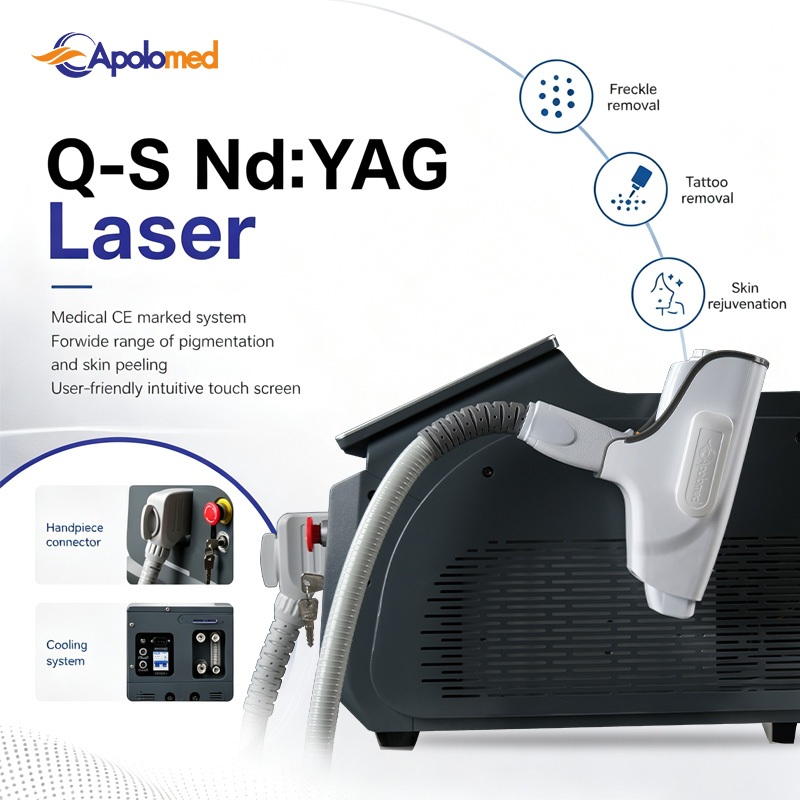
How Nd:YAG Laser Targets Age Spots on Hands via Selective Photothermolysis
The Science: Melanin Absorption and 1064 nm Wavelength Precision
The Nd:YAG (Neodymium-doped Yttrium Aluminum Garnet) laser removes hand age spots through selective photothermolysis—a process that leverages melanin’s preferential absorption of specific light wavelengths. Solar lentigines contain concentrated melanin, which absorbs the 1064 nm wavelength far more efficiently than surrounding skin. This near-infrared light penetrates deeply into the dermis while avoiding significant absorption by water or hemoglobin, allowing precise targeting of pigment without overheating superficial structures.
Once absorbed, laser energy rapidly heats melanosomes, causing them to fragment into microscopic particles cleared naturally by the lymphatic system over subsequent weeks. Crucially, Q-switched Nd:YAG lasers deliver this energy in nanosecond pulses—shorter than the thermal relaxation time of melanosomes—so heat remains confined within pigment granules. This spares adjacent collagen, blood vessels, and the delicate epidermis of the dorsal hand, where thin skin and minimal subcutaneous fat increase vulnerability to thermal injury. The 1064 nm wavelength further enhances safety across Fitzpatrick skin types III–VI by minimizing competitive absorption in epidermal melanin, reducing risks of dyspigmentation.
Clinical Evidence: 82% Clearance Rate for Hand Solar Lentigines After 2 Nd:YAG Sessions
Real-world efficacy is well documented. A 2022 prospective study published in the Journal of Cosmetic and Laser Therapy followed 60 patients with solar lentigines on the hands and found that two Q-switched Nd:YAG treatments—spaced four weeks apart at 2.5 J/cm² fluence and 4 mm spot size—achieved ≥75% clearance in 82% of treated lesions, with no scarring or persistent hyperpigmentation. Mild, transient erythema resolved within 24 hours in all participants, and half were Fitzpatrick skin types III–IV, reinforcing broad applicability.
Notably, hand lentigines responded faster than facial counterparts in a separate 2020 trial—likely due to the thicker stratum corneum on dorsal hand skin, which permits slightly higher, yet still safe, fluences while protecting the dermal-epidermal junction. These findings support a practical treatment paradigm: durable clearance after just two sessions, with maintenance needed only once annually for most patients.
Safety-First Nd:YAG Treatment for Thin Dorsal Hand Skin
Why Lower Fluence + Dynamic Cooling Minimizes Epidermal Risk
Dorsal hand skin presents unique challenges: a thin epidermis, sparse subcutaneous fat, and frequent photoaging—all heightening susceptibility to thermal injury. To mitigate risk, clinicians use conservative fluence settings (2.0–4.0 J/cm²), limiting peak epidermal temperature rise and preventing blistering or post-inflammatory hyperpigmentation. This approach is synergistically enhanced by dynamic cooling devices (DCD), which deliver a cryogen spray milliseconds before the laser pulse, chilling the skin surface to 5–10°C. This pre-cooling creates a protective thermal buffer—preserving the epidermis while permitting sufficient dermal heating to fracture melanosomes.
In practice, pairing 30–50 ms DCD spray duration with appropriately calibrated fluence yields consistent pigment clearance without pinpoint bleeding, crusting, or prolonged erythema—outcomes commonly associated with higher-energy protocols. The result is a high safety margin for a region where even minor epidermal disruption can lead to persistent textural changes or delayed recovery.
Off-Label Efficacy in Fitzpatrick IV–VI Skin: Low Downtime, High Tolerance
Although not FDA-cleared specifically for pigmented lesions in darker skin, Nd:YAG’s off-label use for hand age spots in Fitzpatrick IV–VI patients reflects strong clinical consensus around its safety and tolerability. Its 1064 nm wavelength interacts weakly with epidermal melanin, bypassing the superficial pigment reservoir that often drives thermal injury with shorter-wavelength devices. Consequently, risks of post-treatment hyper- or hypopigmentation are markedly reduced.
Patients typically report only mild stinging during treatment and experience faint, short-lived erythema—resolving within hours. Over the next 5–7 days, treated spots may darken and flake superficially, but peeling remains non-scarring and requires no downtime. Compared to alternatives like IPL or alexandrite lasers—which carry higher dyspigmentation risks in richer complexions—Nd:YAG offers predictable clearance with exceptional patient tolerance, making it a preferred choice for diverse populations.
Nd:YAG Laser vs. Alternatives for Hand Age Spots: A Clinician’s Comparison
Alexandrite Limitations on Pigmented or Thin Hand Skin
Alexandrite lasers (755 nm) absorb more strongly in epidermal melanin than Nd:YAG’s 1064 nm beam—advantageous for some superficial lesions but problematic on the thin, sun-damaged dorsal hand. This heightened absorption increases the risk of hypopigmentation, blistering, and post-inflammatory hyperpigmentation, especially in Fitzpatrick skin types III and above. Even with integrated cooling, clinicians observe less predictable treatment endpoints and often need to reduce fluence significantly—compromising efficacy and sometimes requiring additional sessions. In contrast, Nd:YAG’s deeper penetration preserves epidermal integrity, making it a safer, more reliable first-line option for hands where the dermal-epidermal junction is already compromised by aging and chronic UV exposure.
Pico vs. Q-Switched Nd:YAG: When Pulse Duration Impacts Clearance and Recovery
Q-switched Nd:YAG lasers deliver nanosecond pulses that primarily act through photothermal fragmentation of melanin—proven to clear 82% of hand solar lentigines after two sessions. Picosecond Nd:YAG systems generate pulses ~1,000× shorter, shifting the mechanism toward photoacoustic shockwaves that mechanically shatter pigment. While this may offer marginal advantages for recalcitrant or fine-particle pigmentation—and potentially reduce session count in select cases—it does not consistently translate to superior clinical outcomes for typical hand age spots. Both modalities achieve comparable clearance rates and recovery profiles: transient erythema and mild crusting resolve within 5–7 days. The choice between them often reflects platform versatility, practice economics, and operator familiarity—rather than a decisive clinical advantage for routine hand lentigine treatment.
Frequently Asked Questions
What is the Nd:YAG laser used for?
Nd:YAG lasers are primarily used for treating pigmented lesions, such as age spots and solar lentigines, and are highly effective on hand age spots due to their selective photothermolysis mechanism targeting melanin.
Is the procedure safe for all skin types?
Yes, the 1064 nm wavelength is safe across Fitzpatrick skin types III–VI and reduces risks of dyspigmentation in darker skin tones.
How many sessions are typically needed to clear hand age spots?
Most patients achieve significant clearance (≥75%) of hand age spots in two sessions spaced four weeks apart, with annual maintenance recommended.
What is the recovery time after Nd:YAG laser treatment?
Recovery is typically quick, with mild redness resolving within 24 hours and treated spots darkening and flaking over the following 5–7 days.
How does Nd:YAG compare to other laser types for hand age spots?
Nd:YAG’s deeper penetration and minimal interaction with epidermal melanin make it safer and more effective for thin, photo-aged dorsal hand skin compared to alexandrite lasers, and it provides comparable results to picosecond technology.