 EN
EN

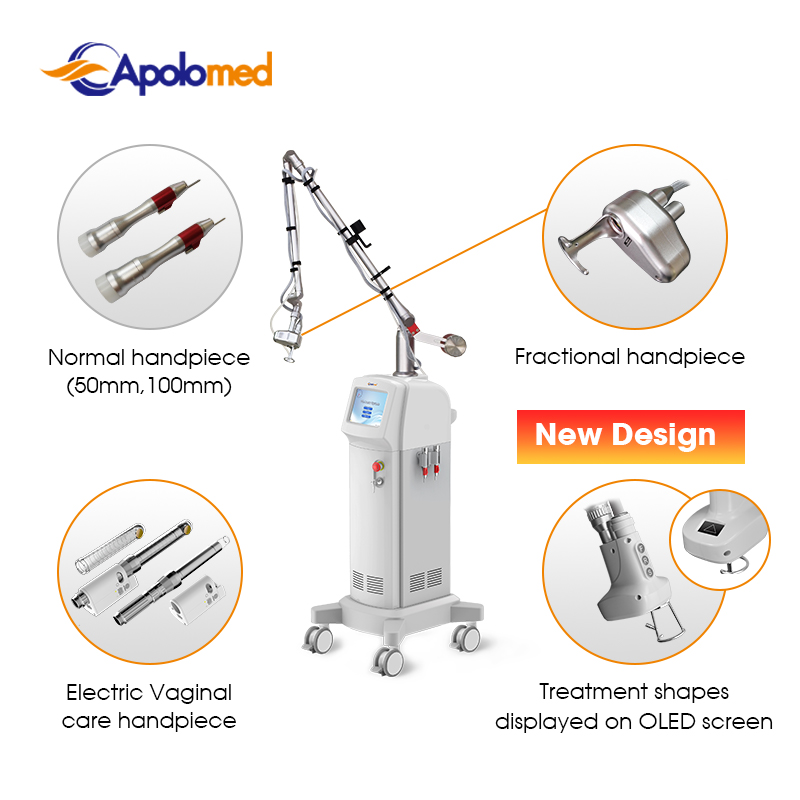
Why Fractional CO2 Laser Is the Gold Standard for Rough Skin Correction
Mechanism: How Fractional CO2 Targets Epidermal Excess and Dermal Texture Irregularities
Fractional CO2 laser operates at a 10,600 nm wavelength—highly absorbed by water in skin cells—enabling precise, controlled ablation. It creates microthermal treatment zones (MTZs) that vaporize excess epidermal keratin and superficial dermal irregularities while sparing surrounding tissue. Thermal energy reaching ~66.8°C triggers immediate collagen denaturation and contraction, launching a robust wound-healing cascade. Fibroblasts respond by synthesizing new collagen (neocollagenesis) and elastin, gradually replacing disorganized fibrotic tissue with a smoother, more organized dermal matrix. Because the fractional approach preserves columns of healthy skin, re-epithelialization accelerates and downtime decreases. For rough, keratinized skin, this dual action—surface ablation and deep remodeling—consistently delivers uniform textural improvement. MTZ depth and density are adjustable to match severity, ensuring both versatility and predictability.
Clinical Validation: Histological and Visual Evidence in Photodamaged, Keratinized Skin
Histological studies confirm fractional CO2 laser significantly increases collagen bundle thickness and improves epidermal-dermal junction organization in photodamaged skin. Biopsies taken three months post-treatment show a 40–60% rise in type I collagen density alongside reduced abnormal elastotic material. Blinded clinical assessments report a 2- to 3-point improvement on standardized roughness scales after one session—with continued enhancement for up to one year. In split-face trials, treated sides demonstrate markedly smoother texture and reduced visible keratosis versus untreated controls. Long-term follow-up confirms sustained collagen remodeling, underpinning the treatment’s durability. These objective tissue-level changes validate why fractional CO2 remains the reference standard for lasting, uniform skin smoothing.
Optimal Fractional CO2 Session Count for Texture Refinement
Mild-to-Moderate Roughness: Evidence Supporting 1–3 Sessions with Progressive Efficacy
For mild-to-moderate roughness, 1–3 fractional CO2 sessions spaced 4–8 weeks apart deliver clinically meaningful smoothing. A single conservative session (e.g., 12–15 mJ, low density) initiates superficial exfoliation and early collagen contraction—but results are often partial. Two to three treatments yield progressive refinement by aligning with the skin’s natural remodeling cycle: each pass stimulates neocollagenesis, and cumulative effects gradually replace disorganized keratinized tissue with smoother, more uniform architecture. Clinical observation shows that three moderate sessions consistently outperform a single high-fluence treatment—not only in texture scores but also in safety and tolerability—by allowing epidermal normalization between sessions and avoiding regenerative overload.
Balancing Efficacy and Downtime: Why Three Conservative Sessions Often Outperform One Aggressive Treatment
A three-session, low-fluence protocol typically achieves superior texture refinement with less downtime than a single aggressive treatment. High-energy single-pass approaches risk prolonged erythema, edema, and post-inflammatory hyperpigmentation—without delivering proportionally greater benefit. In contrast, conservative settings (e.g., 10–20 mJ, density 2–3) produce mild, transient erythema resolving in 3–5 days, while repeated fibroblast stimulation builds a dense, organized collagen matrix. This staggered injury pattern respects the skin’s biological healing window, lowers the risk of thermal fibrosis, and supports consistent patient adherence. As a result, three well-spaced fractional treatments offer more predictable, safer, and socially sustainable smoothing than an ablative-intensive single session.
Personalizing the Fractional CO2 Protocol for Predictable Texture Smoothing
Parameter Tuning: Density, Depth, and Pulse Energy Based on Skin Thickness and Roughness Grade
Predictable texture refinement requires precise parameter customization aligned with skin thickness and roughness grade. In thin, delicate areas like the periorbital region, lower density (5–10%), shallow depth (300–500 µm), and moderate pulse energy (15–30 mJ) minimize epidermal injury while still stimulating dermal remodeling. Conversely, thick, rough, and photodamaged skin—common on cheeks or forehead—typically benefits from higher density (15–25%), deeper penetration (600–1000 µm), and elevated energy (40–60 mJ) to effectively disrupt disorganized collagen and smooth keratinized surfaces. Clinical experience confirms that matching depth to roughness severity minimizes adverse effects: overly aggressive settings on thin skin may cause prolonged redness or scarring, while insufficient energy on thick skin yields suboptimal outcomes. A conservative, incremental strategy—gradually increasing pulse energy across sessions—supports safe, stepwise collagen remodeling and optimal long-term results.
Sustaining Smooth Skin: Collagen Remodeling Timeline and Long-Term Maintenance After Fractional CO2
The lasting smoothness achieved with fractional CO2 laser stems from a biologically driven rebuilding process that unfolds over months—not days. The timeline below outlines key phases of collagen remodeling and their contribution to durable texture improvement.
| Phase | Timeline | Key Changes |
|---|---|---|
| Initial Healing | 5–7 days | Re-epithelialization, crusting, and peeling |
| Early Remodeling | 2–4 weeks | Redness fades; early collagen synthesis begins |
| Active Collagen Production | 3–6 months | Collagen density increases by 20–40% from baseline, restructuring dermal support |
| Final Settling | Up to 6 months | Maturation of collagen fibers; peak smoothness and resilience |
| Long-Term Maintenance | Beyond 6 months | Sustained improvement with protective skincare and optional touch-ups |
Because remodeling continues for months, texture often refines most noticeably between 3–6 months post-treatment. To preserve results, daily broad-spectrum sun protection, gentle moisturization, and a supportive skincare routine—including antioxidants and peptides—are essential. Many patients maintain durable smoothness for 12+ months; periodic low-intensity maintenance sessions can further sustain collagen density without the extended recovery of initial treatments, helping skin stay resilient and even.
FAQs
What is the advantage of fractional CO2 laser over traditional skin treatments?
Fractional CO2 laser targets rough skin both superficially and deeply, delivering faster results with minimized downtime compared to traditional methods.
How many sessions are recommended for rough skin correction?
Typically, 1–3 sessions spaced 4–8 weeks apart are recommended, with adjustments based on individual skin thickness and roughness severity.
Is fractional CO2 laser suitable for all skin types?
While effective for most skin types, parameter customization ensures safe and optimal outcomes, particularly for sensitive or photodamaged skin.
What is the expected downtime after fractional CO2 laser treatment?
Mild redness and peeling often resolve in 3–5 days, allowing most patients to resume daily activities quickly.
Can results from fractional CO2 lasting longer than a year?
Yes, most patients enjoy durable results for 12 months or longer. Regular maintenance sessions and proper skincare can sustain improvements.
Table of Contents
- Why Fractional CO2 Laser Is the Gold Standard for Rough Skin Correction
- Optimal Fractional CO2 Session Count for Texture Refinement
- Personalizing the Fractional CO2 Protocol for Predictable Texture Smoothing
- Sustaining Smooth Skin: Collagen Remodeling Timeline and Long-Term Maintenance After Fractional CO2
-
FAQs
- What is the advantage of fractional CO2 laser over traditional skin treatments?
- How many sessions are recommended for rough skin correction?
- Is fractional CO2 laser suitable for all skin types?
- What is the expected downtime after fractional CO2 laser treatment?
- Can results from fractional CO2 lasting longer than a year?