 EN
EN

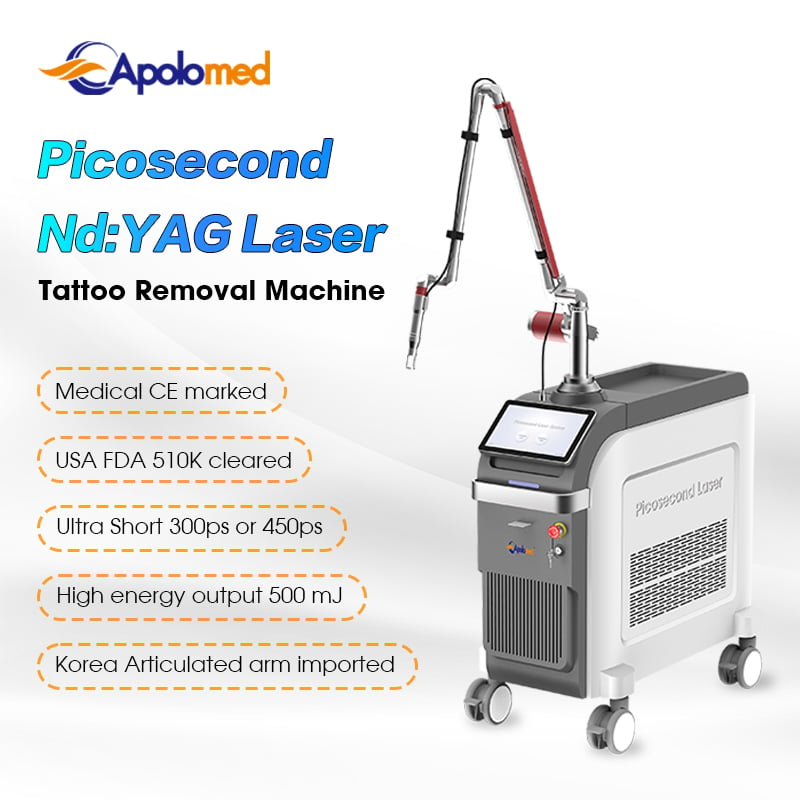
Blog Abstract: Navigating aesthetic laser options for pigmentation, tattoo removal, and skin rejuvenation can be confusing—especially when comparing traditional Nd:YAG and picosecond technology. While both systems often utilize the same 1064nm and 532nm wavelengths, their fundamental difference lies in pulse duration. This article breaks down how nanosecond vs. picosecond energy delivery affects tissue interactions, treatment speed, clinical outcomes, and overall patient comfort.
1. The Core Technical Difference: Pulse Duration
The distinction between a traditional Q-switched Nd:YAG laser and a picosecond Nd:YAG laser is not the underlying wavelength, but rather the speed of energy delivery:
-
Q-Switched Nd:YAG (Nanosecond): Delivers energy in billionths of a second ($10^{-9}$ seconds).
-
Picosecond Laser: Delivers energy in trillionths of a second ($10^{-12}$ seconds). One picosecond equals $0.01$ nanoseconds.
Photothermal vs. Photomechanical Mechanisms
Because a Q-switched nanosecond laser holds energy on target longer, it relies primarily on a photothermal effect (heat). This thermal energy heats pigment particles to break them down, but it also diffuses heat into surrounding tissue, increasing the risk of collateral thermal damage and post-inflammatory hyperpigmentation (PIH).
In contrast, a picosecond laser operates so rapidly that it triggers a photomechanical (photoacoustic) shockwave. The acoustic pressure shatters targeted pigment or tattoo ink into dust-like micro-particles with minimal heat diffusion, enabling faster clearance by the body's lymphatic system.
2. Clinical Benchmarks and Efficacy Comparisons
Comparative dermatological studies highlight distinct performance differences between the two modalities across various indications:
Clinical Performance Overview
-
Pigmentation Clearance: Studies demonstrate that picosecond Nd:YAG lasers frequently achieve higher percentage clearance rates over fewer sessions compared to standard nanosecond systems.
-
Tattoo Removal: The photomechanical breakdown of dense tattoo inks creates smaller particle fragments, allowing macrophages to clear ink more efficiently. Black, dark blue, and stubborn red inks clear in fewer total treatment passes.
-
Melasma & Sensitive Skin: By minimizing collateral thermal buildup, picosecond 1064nm protocols reduce heat-induced melanocyte activation, making them safer for chronic hyperpigmentation and darker skin types (Fitzpatrick III–V).
3. Wavelength Versatility and Tissue Interaction
Both modalities leverage specific wavelengths to target different dermal and epidermal layers:
-
1064nm Wavelength: Penetrates into the deep dermis, targeting dermal pigment (such as Nevus of Ota or deep melasma) and dark tattoo inks (black/blue).
-
532nm Wavelength: Focuses on superficial epidermal layers, making it ideal for sunspots, freckles, and red/warm-toned tattoo pigments.
-
Fractional Arrays: Modern picosecond systems often incorporate micro-lens arrays (MLA) to generate Laser-Induced Optical Breakdown (LIOB) in the dermis. This stimulates neocollagenesis and elastin production for acne scar revision and skin rejuvenation without ablating the surface.
4. Safety, Comfort, and Recovery Landscapes
Because picosecond energy delivery limits excess heat, overall patient recovery and procedural safety parameters are optimized:
-
Reduced Thermal Discomfort: Patients typically experience lower pain levels during treatment due to minimized photothermal stimulation of cutaneous nerve endings.
-
Lowered Risk of PIH: Reduced thermal injury drastically lowers the incidence of post-inflammatory hyperpigmentation, particularly in darker skin types.
-
Minimal Downtime: Non-fractional and fractional picosecond sessions typically involve brief erythema (redness) that resolves within 24 to 48 hours, allowing patients to resume normal daily activities promptly.
5. Conclusion
While traditional Q-switched Nd:YAG lasers remain dependable workhorses for baseline pigment and vascular concerns, picosecond Nd:YAG lasers represent a major technological evolution. By shifting from photothermal heating to photomechanical shockwaves, picosecond platforms achieve superior pigment fragmentation, faster treatment timelines, and greater overall procedural safety.
Tags: #Dermatology #PicosecondLaser #NdYAG #PigmentationTreatment #TattooRemoval #AestheticMedicine #LaserPhysics